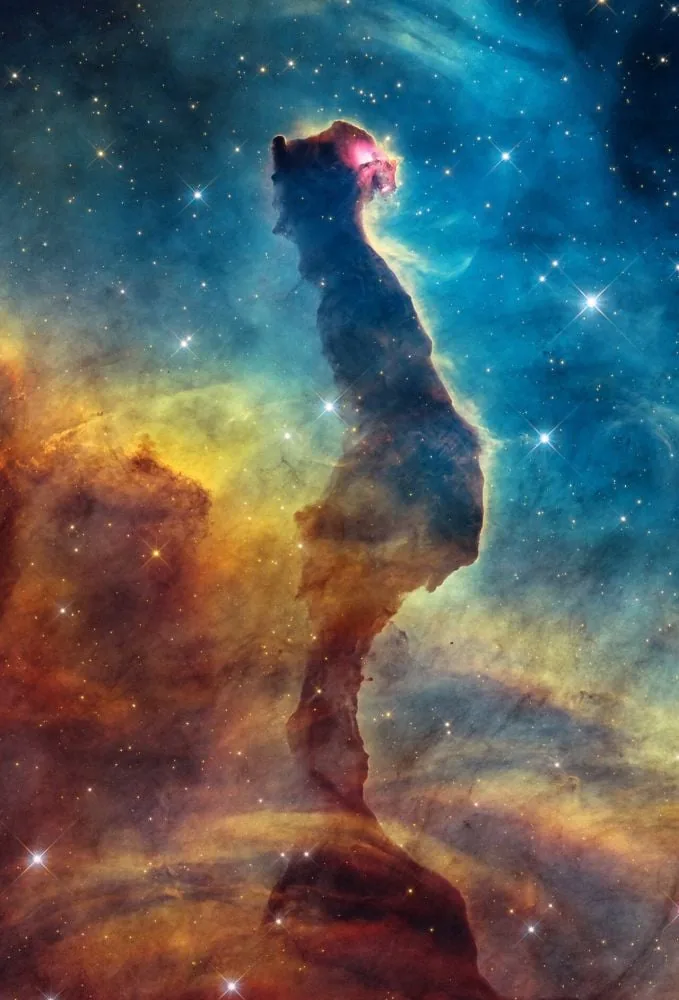
The Complex Dynamics of Stellar Nurseries
Star formation remains one of the most intricate and multi-layered topics in modern astrophysics. This evolutionary pathway depends heavily on a delicate balance of physical parameters, including metallicity, gas temperature, volume density, and the properties of interstellar dust grains. To understand how these forces interact to ignite new stars, astronomers are turning their attention to one of the most spectacular structures in the cosmos: the Cat's Head nebula, nestled inside the broader Carina Nebula. This complex region offers a prime natural laboratory for deciphering the fundamental physics governing stellar birth.
Multi-Wavelength Views from Hubble and JWST
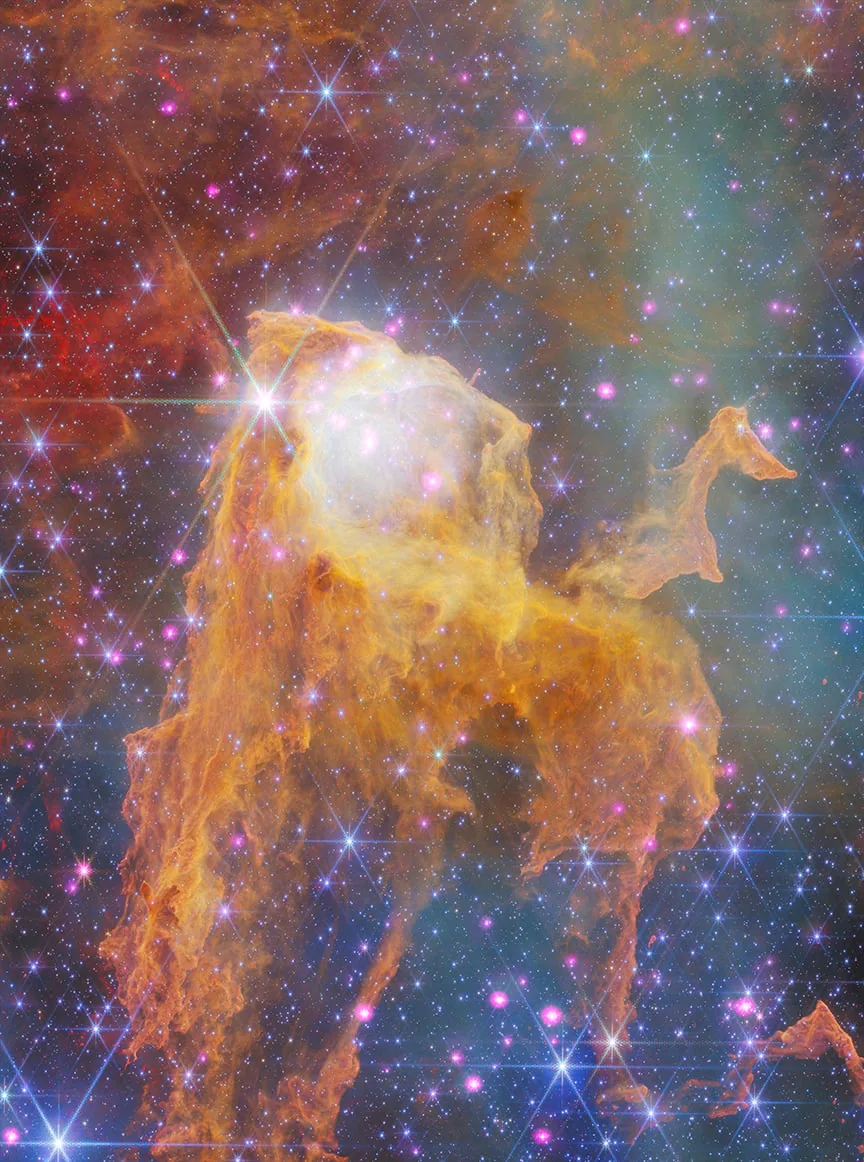
By leveraging the complementary capabilities of the Hubble Space Telescope and JWST, researchers are dissecting the intricate architecture of the Cat's Head nebula across different wavelengths. The high-resolution optical and infrared views allow scientists to peer through obscuring dust grains and map localized temperature fluctuations in the gas. Crucially, the observations track stellar feedback from existing luminous stars, demonstrating how stellar winds and intense radiation carve through surrounding matter, either dispersing the gas or compressing it into dense pockets ripe for collapse.
Refining Galactic Star Formation Models
Studying this detailed sub-structure within the Carina Nebula does not merely explain a single cosmic formation; it provides vital empirical ground truth for large-scale astrophysical models. Pinpointing how gas density, dust composition, and chemical metallicity regulate the pace of star birth helps astrophysicists calibrate evolutionary simulations across entire galaxies. The combined imaging prowess of Hubble and Webb paves the way for a deeper theoretical understanding of how the universe's most massive stellar nurseries evolve over millions of years.
Comments
Loading comments...