Black Hole Jets and Observational Challenges
Powerful jet ejections of high-energy photons and particles from black holes are among the most energetic astrophysical phenomena in the universe. While these intense outbursts offer critical insights into extreme physical processes, accurately predicting when a jet ejection will occur has long presented a major challenge for astronomers.
X-ray Analysis and Accretion Disk Dynamics
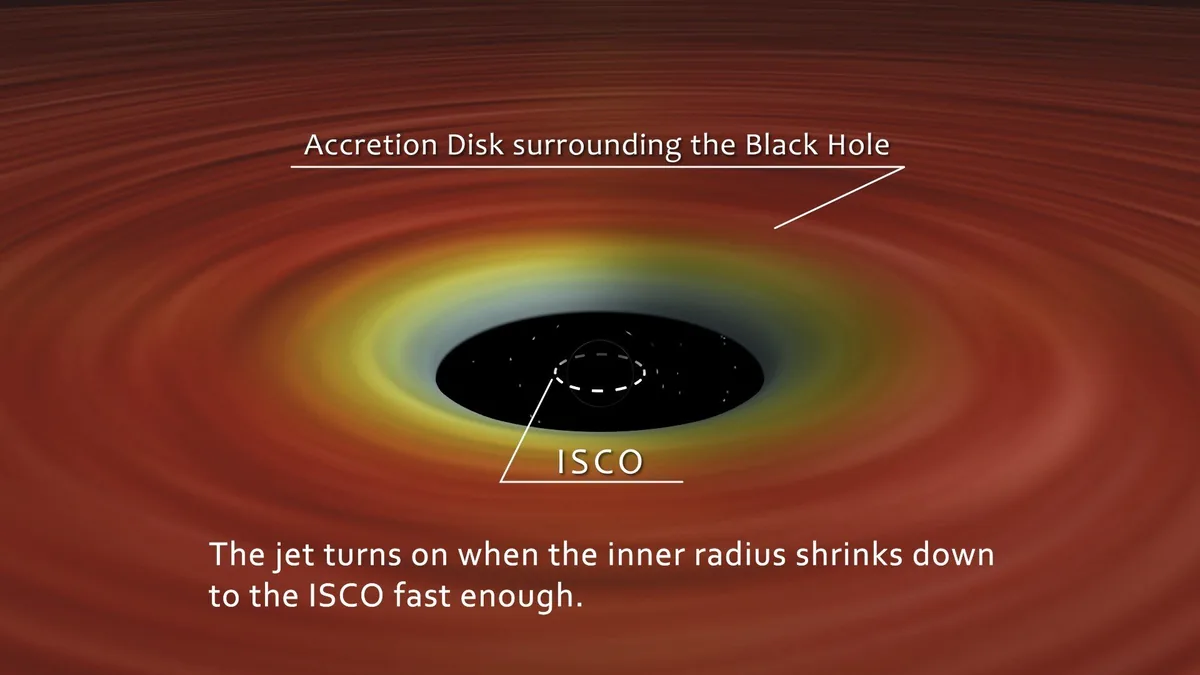
To better understand these triggering mechanisms, researchers in Japan analyzed X-ray observations from four distinct black hole binary systems. Their detailed analysis identified that a reduction in the inner radius of the surrounding accretion disk, combined with specific shifts in emitted X-ray variability, can serve as reliable predictors for upcoming jet ejections.
The observational data demonstrated that as the accretion disk contracts toward the black hole, characteristic variations in X-ray emissions emerge right before the high-energy jet is launched. These physical markers provide valuable technical clues regarding the behavior of matter under extreme gravitational forces.
Advancing Astronomical Forecasting and Multi-Telescope Coordination
These findings provide astronomers with a new framework to forecast powerful black hole outbursts with much greater accuracy. By anticipating the precise onset of jet ejections, research teams will be able to coordinate multi-wavelength observational campaigns in a timely manner, capturing these fleeting events in unprecedented detail.
Comments
Loading comments...