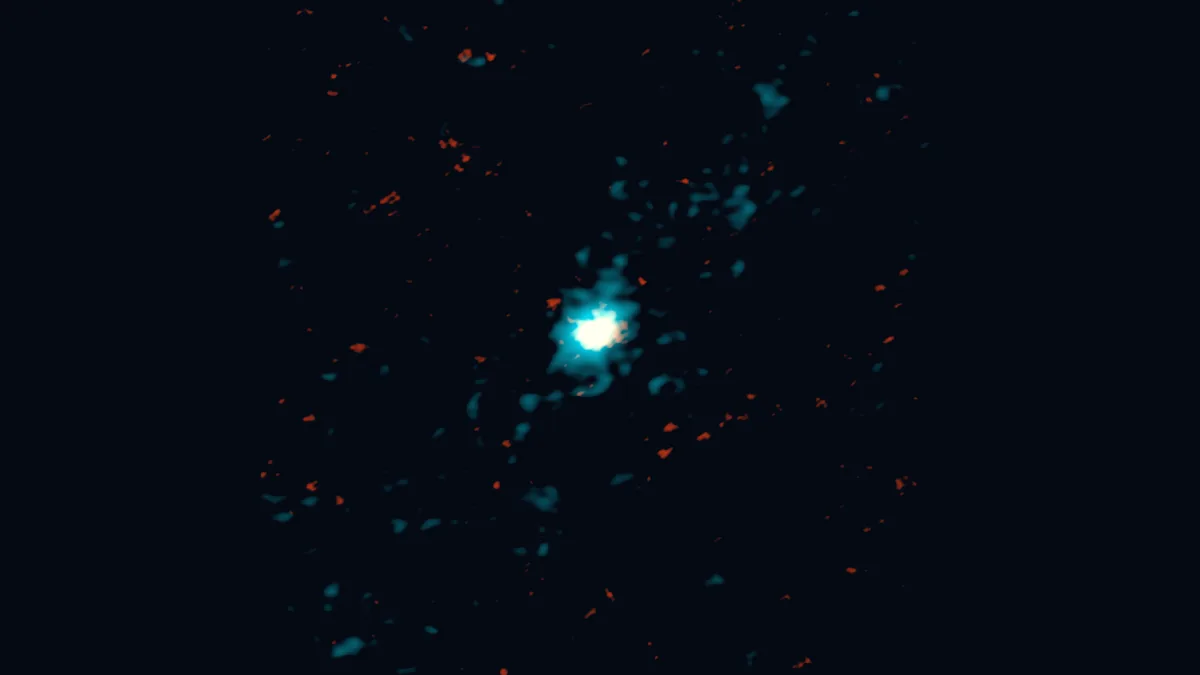
A Colossal Monster in the Early Universe
Astronomers utilizing the Atacama Large Millimeter/submillimeter Array (ALMA) in Chile have conducted detailed observations of an extreme system in the early universe. By targeting the galaxy WISE J224607.56−052634.9 (also known as W2246-0526), whose light has traveled for more than 12 billion years to reach Earth, the team directly measured the mass of its central supermassive black hole.
Tracing Gas Kinematics and Gravitational Reach
ALMA's high-resolution millimeter and submillimeter capabilities resolved the motions of gas swirling near the core of the galaxy. By analyzing how this material moves under the immense gravitational pull of the center, scientists determined that the black hole possesses a mass roughly 6.5 billion times that of the Sun, successfully mapping its gravitational domain in the early cosmos.
Implications for Early Galaxy Evolution
The existence of a black hole containing billions of solar masses when the universe was in its relative infancy provides vital constraints for astrophysical models. Understanding the interplay between gas accretion and gravitational influence in W2246-0526 offers valuable clues into how the first generations of galaxies and supermassive black holes formed and grew so rapidly.

Comments
Loading comments...