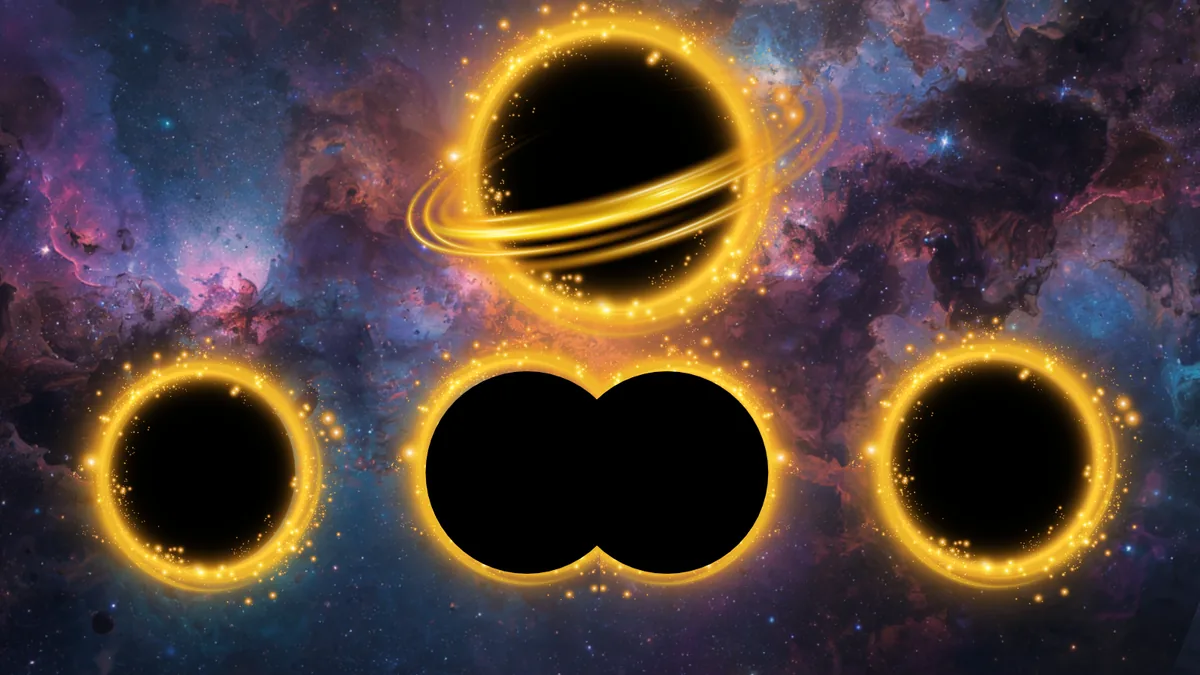
Dynamics of Black Hole Mergers and Splitting
Astronomers and theoretical physicists have spent decades studying the evolution of black holes, some of the most enigmatic objects in the universe. Until now, the widely accepted scientific consensus was that when two black holes interact gravitationally and collide, they merge to form a single, more massive black hole. However, new theoretical research suggests that the reverse process can also occur, sparking tremendous excitement in the astrophysics community.
The findings presented by the new study propose that under specific physical conditions, a single black hole can actually split into two independent entities. This finding introduces a fresh perspective on gravitational physics and black hole dynamics.
The Role of Extreme Spin Speeds and Physical Processes
Theoretical calculations and modeling reveal that for a black hole to split in two, a highly specific condition must be met: the black hole must spin on its axis at extreme speeds. Possessing extremely high angular momentum, such rapidly spinning black holes can reach an unstable equilibrium as rotational forces interact with gravitational collapse.
Physical analysis indicates that this critical spin threshold causes severe deformation along the black hole's event horizon. Disrupted by extreme rotational speeds, the structure can eventually pinch off and separate, forming two distinct black hole cores.
Theoretical Models and Future Observation Plans
This theoretical revelation may require a reevaluation of black hole populations and mass distributions across the cosmos. Astrophysical models previously built solely on merger scenarios will now need to account for fragmentation and splitting mechanisms. The research team's findings open a new window into explaining the existence of various black hole mass scales.
Future gravitational wave observations and specialized telescope surveys aim to detect extremely fast-spinning black holes and potential signatures of splitting events. These efforts could fundamentally alter our understanding of how black holes evolve in galactic centers.

Comments
Loading comments...